September 17, 2016

Biscuit Brats


Germany doesn't seem to have much in the way of sausage rolls, despite their willingness to incorporate sausages into almost every other part of the cuisine. There are various bread-y Stangen ("rods" or "poles") which might contain a more wiener-style sausage as a sort of topping, and the less common Geflügel Rolle ("Poultry Roll"), which actually comes closest, I guess, while also managing to be completely different.

Normally when I make sausage rolls, I use puff pastry. While that is definitely an option here - either housemade rough-puff or purchased from the refrigerator section of the supermarket, I wanted something that I could knock together at a moment's notice without a trip to the store. Since I frequently have some bratwurst on hand, and almost always have the necessary components for making biscuits, I found it logical to combine them. These are the results of my first foray.

I note that I started with wide, uncooked bratwurst, but I would either switch to narrower sausages or pre-cook them next time to avoid oven-time past the point of the biscuit being cooked, to avoid any toughening of the exterior.

Biscuit Brats

500 grams fresh bratwurst
2 cups all purpose flour
4 teaspoons baking powder
1/2 teaspoon coarse salt (eg. Kosher or sea salt)
1/2 teaspoon cream of tartar
1 teaspoon sugar
1/3 cup butter
3/4 cup milk

Preheat the oven to 220 C/ 450 F.

Take a sharp knife and run it down the length of each sausage, slicing just through the casing. Carefully peel the cases away and discard. The sausages should retain their shape and integrity. If you're going to precook the sausages (probably a good idea if you're using thick ones), you can do it now, by sautéing them gently over medium heat until barely cooked through. Put them aside to cool while you make the biscuit dough.

In a medium mixing bowl, sift together the dry ingredients - to be fair, I don't really sift, I aerate them with a whisk, but do whichever pleases you most. Using a pastry-blender or a fork (and a lot of patience), cut in the butter until the mixture is crumbly and the little lumps of fat are about corn-kernel sized.

Create a well in the middle of the mixture and pour the milk in all at once. Hold the bowl steady and, using a fork, stir rapidly and briefly until the dough comes together in a ragged mass. Quickly dump it out onto a clean counter, and knead very lightly and briefly until all the flour is incorporated. You may need to add a little extra flour, but probably not. Go cautiously - too much flour makes tough biscuits.

Pat out the dough into a rectangle, and then roll with a rolling pin or bottle to get a dough that is about a centimetre thick. Lay one of the sausages along the edge to mark the length, and slice the dough accordingly. Roll the sausage along the dough to see where to cut it to make an exact cylinder of biscuit dough to surround the sausage. Cut the dough, and either use it as a template for the other sausages, or repeat with each sausage. If you have any leftover dough, you can simply cut it into rough biscuit shapes, and cook them alongside.

Lay the sausages in the middle of the squares of biscuit dough. If you want to get fancy and add some additional seasonings - a bit of curry powder, or cayenne, perhaps? - sprinkle it over the sausages now. Wrap the dough carefully around each sausage, pressing the seam gently to make sure it doesn't separate while cooking.


(You can see which one has cayenne, here)

Place the rolls on an ungreased cookie-sheet and bake for 15 minutes (may need 10 min longer if starting with large, raw sausages), or until they have gotten tall and golden. Serve with a bit of mustard, or ketchup (regular or curry) if that's your thing.

These are very filling, and make an excellent lunchbox item.

September 03, 2016

Curried Spaghetti with Prawns


This dish is essentially a hybrid other recipes, which came together as I was fondly recollecting the kind of curried pasta that was always on the menu of a certain kind of casual Canadian-Italian restaurant in the late 1980s. That said, this one owes most of its technique to Nigella Lawson's Lone Linguine with White Truffle Oil, although my proposed serving size is smaller than hers by half. So by all means, go ahead and add a couple of slices of your favourite garlic toast.

You could also use fresh spinach in place of the arugula, of course, but I like the peppery bite of the arugula against the richness of the sauce. A glass of Pinot Grigio goes remarkably well with this, too, if you're so inclined.

It's really fast to make. Basically, in just the amount of time it takes to boil the water, cook the pasta, and toss it all together, dinner is ready. Perfect weeknight fare.

You can use whatever kind of curry powder you like, or blend your own. I’ve used a hot Indian curry powder, but Madras would be nice, or even a Caribbean curry blend.

Curried Spaghetti with Prawns

Serves 2

112 grams spaghetti
1 egg, beaten
3 tablespoons whipping cream
3 tablespoons grated parmesan cheese
1/4 tsp curry powder
1 1/2 tablespoon unsalted butter, divided
225 grams raw prawns or large shrimp, deshelled
1 1/2 cups arugula

Set a pot of water (for pasta) to boil over medium-high heat.

For the prawns, rinse them well under cool water and let defrost in a bowl of cool water until they regain their flexibility. Drain thoroughly, and pat dry with a paper towel (they should not go into the skillet wet).

Salt the now-boiling water and add the pasta. Cook al dente or to taste. That's about 10 minutes for the spaghetti I have at hand, but check your packaging. If you're serving garlic bread, make sure it's already underway by this point.

While the pasta cooks, whisk together the egg, cream, Parmesan, and curry powder in a small mixing bowl. If your curry powder is salt-free, you may wish to add a pinch of sea salt.

Wash the arugula and shake off excess water; no need to spin it dry.

Just before the pasta is ready, heat a large skillet over high heat, and add a tablespoon of the butter, swirling until it foams out and the pan is thoroughly hot. Note: Don’t put all the prawns in the skillet at once, or they will steam, not sauté. Add half the prawns to start, scattered around the pan, then wait a few seconds before adding the rest. Sauté the drained and dried prawns briefly over high heat until just opaque, and then lay the arugula overtop to wilt. Turn off the heat under the skillet.

When the pasta is ready, remove 1/2 cup of the pasta cooking water and reserve (you won’t need all of it, though). I use a glass measuring cup to do this, but a clean mug will do. Drain the rest of the water.

Add the drained pasta to the skillet, on top of the arugula, and then add the remaining half-tablespoon of butter. Toss well with a pasta fork and a spatula, or a couple of forks.

Add about a tablespoon of the reserved, hot pasta-water to the egg mixture, and whisk it well. Then add the egg mixture to the skillet all at once, and stir and toss until that the pasta becomes lightly coated with the sauce, and the sauce becomes smooth (because the Parmesan will have melted, and the egg thickened). This takes only a couple of minutes, max. Taste to see if it needs any salt and adjust as needed. It is important to do this off the heat, or you will end up with scrambled eggs instead of a silky sauce. Still tasty, but *shrugs* not quite as good texturally.

Transfer to plates or bowls and serve immediately.

August 10, 2016

International Bento: Guam - Chamorro Red Rice


It's a funny thing, but I've been making this for quite a number of years, thinking that it was Mexican red rice. It is not. I mean, it makes sense, because Mexican cuisine makes good use of achiote seeds, and that is what gives the rice that nice red colour. I'm not even sure at what point I made the decision to make this dish, but it was cobbled together out of solid rice pilaf theory and the vague knowledge of Mexican red rice being a real thing. Which, of course, it is. It's just not this.

So recently, I had an idle moment of wondering how far my red rice differed from classic Mexican versions (taking into account that there are probably a few variations), and was startled to discover that what I was making didn't even come that close. Amused at my assumptions, I did a bit more creative googling, and discovered that what we have been happily devouring for several years now, is in fact a Guamanian dish called Chamorro red rice. The name Chamorro denotes the indigenous people of Guam (the name Chamorro also applies to the indigenous people from the Northern Mariana Islands).

Unsurprisingly, there are quite a few different styles of this dish, too, including everything from bacon to peas. While many of the recipes use a very generous amount of oil, mine is more modest, meaning that the rice can go comfortably with a richer dish without feeling too heavy.

The biggest difference that I found between my recipe and most of the others available online, is that I grind the achiote seeds and use the resulting powder in the dish, rather than simply soaking them in water to colour the water, which is then used to flavour and colour the rice.

Chamorro Red Rice

Serves 4

200 grams parboiled rice
1/2 tablespoon peanut oil
1/2 small yellow onion, finely chopped
2 cloves of garlic, minced or crushed
1 heaping teaspoon annatto seeds, ground
1/4 teaspoon coarse sea salt
1/2 teaspoon ground cumin
375 mL water and 1 teaspoon vegetable base (or equivalent vegetable broth)

Heat the oil in a medium pot (one with a tight-fitting lid). Sauté the onion and garlic in the oil, and then add the ground annatto, cumin, and salt. Stir well, then add the rice and stir until the grains are evenly coated with oil.

Add the water and vegetable base (or broth), stir, and bring to a boil. Turn the heat to the lowest possible setting, and allow to cook gently for 15 minutes (covered). Then remove the pot from the heat (don't just turn the burner off) and let it sit for another 5 - 10 minutes before you lift the lid. Fluff with a fork and serve.

So what else is in the bento pictured above? Smokey roasted chicken thigh (bone removed post cooking) and corn seasoned with lime juice, salt, and ancho powder.

I think this dish goes particularly well with Margarita Chicken.

July 17, 2016

German baking: Amerikaner


There are various stories about why this popular treat is called an "Amerikaner", but none are particularly satisfactory. My favourite is that the traditional leavener, ammonium hydrocarbonate (or bicarbonate), could be shortened to "ami-ca", which doesn't make much more sense in German. The German word for the above is either Hartshornsalz (ammonium bicarbonate) or Hirschhornsalz (ammonium hydrdocarbonate) -- literally, "deer horn salt".* The use of either of these ammonia salts gives a unique texture and flavour, and although recipes abound that call for baking powder, it seems generally agreed that those ones are lacking in the special signature flavour created by the Hirschhornsalz.

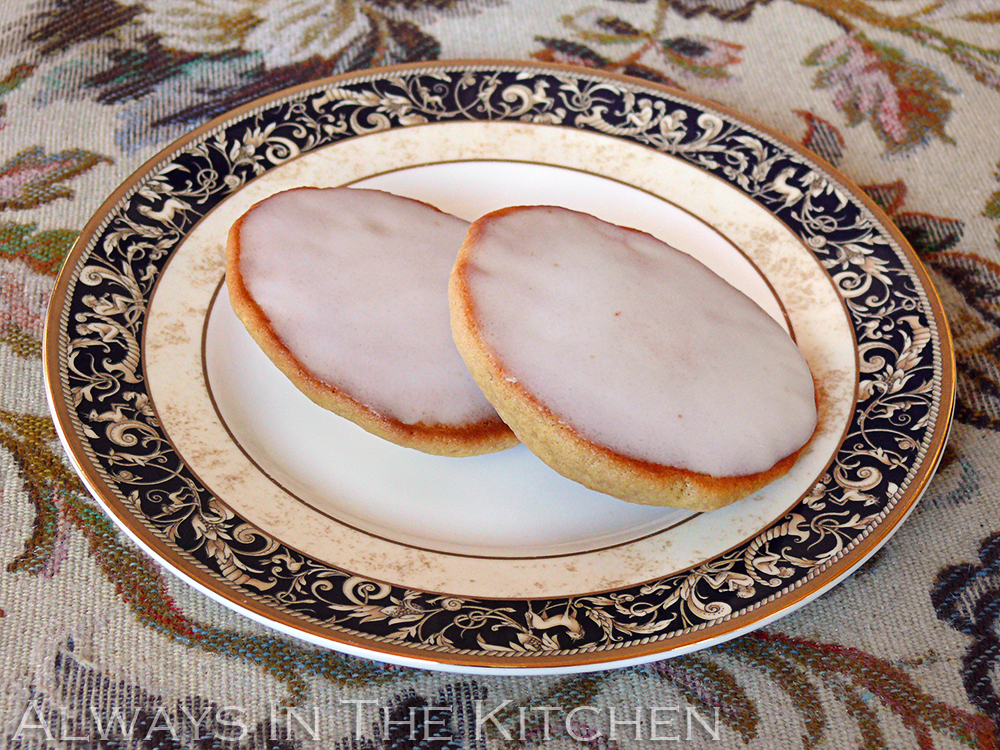
German baking categories don't include soft cookies in with the firm/hard ones. The soft ones are regarded as a small cake, even though as single portions go, they're dauntingly large. Think of an oversized muffin top with the texture of a velvety pound cake, that has been flipped upside down and glazed on the flat side. Locally, these are most often made with a white glaze, although a couple of places offer half-and-half white and chocolate glazing. They are sometimes compared to American Black-and-Whites -- another possible origin story.

I decided to make smaller ones, for better portion control. The regular ones are twice the size of these. I used a disher to scoop the batter, but in order to get the coveted perfectly round shape, next time I will probably use a pastry bag to pipe the wet batter onto the parchment paper. It's definitely a learning process.

A final note on ingredients - most of the recipes I've seen online call for a package of vanilla pudding powder, which is merely cornstarch with vanilla flavour and a pinch of salt. I've added these ingredients separately.

Safety note: ammonium bicarbonate is an irritant to the skin, eyes, and respiratory system. The heat from your oven causes a certain amount of it to sublimate, which releases it as a gas into the hot air inside your oven. If your face is in front of the oven door when you open the oven to remove the cookies, you will get a face-full of ammonia gas. Don't do it; instead, shield your face whilst opening the oven door, to give the gas a chance to disperse. If possible, open a door or window or use a hood fan for additional ventilation while you are cooking with this chemical. For more information, click here.

Amerikaners

Makes about 20 "small" cookies

100 grams unsalted butter, softened to room temperature
100 grams sugar (I used raw sugar, but it wasn't specified)
2 eggs, beaten
1 teaspoon vanilla extract
1/3 cup minus one teaspoon milk
3 tablespoons cornstarch
1 pinch of salt
250 grams cake flour
5 grams ammonium hydrocarbonate/bicarbonate (if you must substitute, try 2 teaspoons baking powder)

For the glaze

250 grams confectioner's sugar
Enough lemon juice and/or water to make a thick glaze

Preheat the oven to 190 C Over/under (375 F) with a rack in the middle.

In a mixing bowl, combine the butter and sugar and beat until light. Add the eggs, beating well after each addition, until fully incorporated. Add the vanilla extract to a 1/3 cup measure, and fill the rest with milk. Add to the butter/sugar/egg mixture, and beat well.

In a smaller bowl, combine the flour, cornstarch, ammonium bicarbonate, and salt. Stir to combine. Add the flour mixture to the wet mixture, and stir just to combine. Note: ammonium bicarbonate stinks like, well, ammonia. This will disappear as it bakes. Try not to inhale too deeply.

Line a baking sheet with parchment paper. Drop or pipe about a tablespoon of batter onto the parchment and test-bake for 8 - 10 minutes to see if it spreads out the way it should (if not, you may need to add another tablespoon of milk).

Bake, watching it like a hawk - you do not want these to burn. They should remain pale, but get a bit golden on the bottom. Repeat until you've used all the batter.

If the dough spreads to your satisfaction, lay out six more cookies on the parchment paper (remember to give them lots of room to spread in all directions) and bake until just golden. They will be very tender and a bit fragile. Remove them to a rack to cool, and spread the bottoms thickly with glaze, leaving them glaze-side up to set.

* While ammonium hydrocarbonate was originally harvested from deer horn, amongst other things, this brand is vegan so no deer were harmed or used in the making of this recipe.

July 03, 2016

Harira


I continue to be inspired by my vacation in Marrakech last year, and as you can see I have many more Moroccan recipes still to explore.

Harira is a traditional soup from Morocco, and while it is enjoyed year-round as an appetizer or light meal, it gains particular significance during Ramadan, for many households being a significant dish for iftar, the traditional meal that breaks the daily fasting during that month. Its recipes are as varied as the households they come from, but generally are all based on a combination of tomatoes, legumes, a starch such as rice or pasta, green herbs, and spices. Meat is an optional component, but used in fairly small quantities as it is not the focus of the soup. I've used lamb in this version, because we have such an excellent supplier of good quality lamb that I cook with it as often as I can, but beef or chicken could be used instead or the meat could be omitted entirely. For a meatless, vegan harira, I would double the amount of lentils, and possibly also increase the amount of chickpeas.

The soup is thick and hearty, and always served with bread. As part of iftar, it might also be accompanied by dates, hard boiled eggs, small savoury pastries, even homemade pizza. Iftar is served just after sundown, and although it is Ramadan right now, we are not Muslim so we enjoyed the harira at our usual dinnertime.


This version of harira is pretty close to the one I first tried at the market restaurants that spring up every evening in Jemaa El Fna, the main square of Marrakech. It is adapted from MarocMama's recipe.

Harira with Lamb

Makes 7-8 cups

1 medium yellow onion
4 cloves garlic
5 large roma tomatoes
225 grams lamb, diced small (optional)
1 cup chopped parsley
1/2 cup chopped cilantro
4 tablespoons tomato paste
1 tablespoon olive oil
3/4 teaspoon salt
1 1/2 teaspoons black pepper
1 tablespoon sweet paprika
1 tablespoon turmeric
1 small pinch saffron, crushed between fingers (optional)
400 grams cooked chickpeas
1/4 cup dry green or brown lentils (washed)
30 grams spaghettini or other thin pasta (broken into short lengths)
1/2 cup unbleached all-purpose flour
5 cups water

Prepare your mise en place: roughly chop the onion and garlic together, and the tomatoes and herbs each separately.

In a food processor, puree the onion and garlic until smooth (a tablespoon of water may help this process).

In a Dutch oven, heat the olive oil over medium heat. Add the onion/garlic puree, and stir and cook for a few minutes. Increase the heat slightly, and add the meat, if using. Stir and cook the meat until it has lost its raw look on all sides.

Add the tomatoes to your now-empty food processor and quickly puree. Add the pureed tomatoes, tomato paste, chopped herbs, salt and the spices, and stir well. Add four of the five cups of water, and bring up to a simmer. Add the washed lentils and chickpeas, and stir through. Reduce the heat to a bare simmer, and let cook for an hour, to let the lamb get tender. This can be reduced to 30 minutes if you aren't using the meat - long enough for the lentils to get tender.

While the soup is simmering, whisk together until smooth the remaining cup of water with the flour. Let it stand while the soup cooks, so that the flour fully hydrates.

When the lentils are cooked and the lamb has had some time to get tender, add the broken pasta and stir through. Then, stirring constantly, add the flour/water mixture in a thin, steady stream. The soup will start to thicken very rapidly, but keep stirring it until all of the flour mixture has been added. This is a very thick soup. Cook and stir for another 20 minutes, to allow enough time for the raw taste of the flour to cook out, and for the pasta to cook. You will need to keep the burner on its lowest heat and stir the soup regularly, to prevent the scorching. Serve as an appetizer or whole meal, with bread and any other accompaniments you like.